
Govardhan Puja 2026: Why Is It Celebrated Two Days After Diwali?
❤️ Spread the Love
Diwali and Govardhan Puja are closely connected in the Hindu festival calendar. Traditionally, Govardhan Puja is observed immediately after Diwali, marking a day dedicated to Lord Krishna, gratitude towards nature, and the importance of protecting the environment.
However, the festival calendar looks slightly different in 2026.
While Diwali will be celebrated on Sunday, November 8, 2026, Govardhan Puja falls on Tuesday, November 10, 2026, leaving a one-day gap between the two festivals.
This difference has raised an interesting question among devotees: Why is Govardhan Puja not being celebrated on November 9?
The explanation lies in the Hindu Panchang and the timing of Kartik Shukla Pratipada, the lunar day traditionally associated with Govardhan Puja.
Let's understand what makes the 2026 festival calendar different, along with the correct puja date, auspicious timings and religious significance of this sacred occasion.
Govardhan Puja 2026: Date and Shubh Muhurat
According to the Hindu Panchang, Govardhan Puja, also known as Annakut Puja, will be observed on Tuesday, November 10, 2026.
The festival falls on the Pratipada Tithi of Shukla Paksha in the Hindu month of Kartik.
Here are the important timings for New Delhi:
Particulars | Date and Time |
|---|---|
Govardhan Puja Date | Tuesday, November 10, 2026 |
Pratipada Tithi Begins | November 9, 2026, at 12:31 PM |
Pratipada Tithi Ends | November 10, 2026, at 2:00 PM |
Govardhan Puja Morning Muhurat | 6:40 AM to 8:50 AM |
Auspicious Morning Duration | 2 hours 10 minutes |
Note: These timings are calculated for New Delhi. Devotees should consult their local Panchang for city-specific muhurat details.
Why Is Govardhan Puja Not Celebrated on November 9 in 2026?
The one-day gap between Diwali and Govardhan Puja in 2026 is due to the timing of Amavasya and Pratipada Tithi. Unlike the Gregorian calendar, where a new date begins at midnight, the Hindu festival calendar follows lunar calculations. A Tithi is determined by the changing angular relationship between the Sun and the Moon, and it can begin or end at any time of the day.
In 2026, Pratipada Tithi begins at 12:31 PM on November 9 and continues until 2:00 PM on November 10. This means that at sunrise on November 9, Amavasya Tithi will still be in effect. However, by sunrise on November 10, Pratipada Tithi will be prevailing.
According to the traditional sunrise-based rule used for Govardhan Puja, the festival is therefore observed on November 10. This is why the celebration falls two calendar days after Diwali rather than on the following day.
The important point is that the date has not been shifted arbitrarily. It follows the prescribed lunar-day calculation.
Also Read: Choti Diwali and Diwali on the Same Day in 2026
What Is the Significance of Kartik Shukla Pratipada?
Kartik Shukla Pratipada is the first lunar day of the Moon's waxing phase in the month of Kartik. This Tithi is considered significant in several Hindu traditions, particularly those associated with Lord Krishna and the worship of Govardhan Hill.
Devotees traditionally observe Govardhan Puja during this period to commemorate Lord Krishna's protection of the people of Braj. The festival is also associated with Annakut, a devotional offering in which a variety of freshly prepared dishes are presented to the deity.
In different parts of India, Kartik Shukla Pratipada is connected with additional customs, including Bali Pratipada and regional New Year celebrations. Although these traditions vary, they share themes of renewal, thanksgiving, prosperity, and devotion.
The Story Behind Govardhan Puja: Why Did Lord Krishna Lift Govardhan Hill?
The religious significance of Govardhan Puja is rooted in one of the most celebrated stories from Lord Krishna's childhood. According to the Bhagavata Purana, the people of Braj traditionally performed rituals honouring Lord Indra, the deity associated with rain.
Young Krishna questioned this practice and encouraged the villagers to recognise the importance of Govardhan Hill, the forests, the land and the cows that sustained their daily lives. Following Krishna's guidance, the villagers offered their prayers and food to Govardhan Hill.
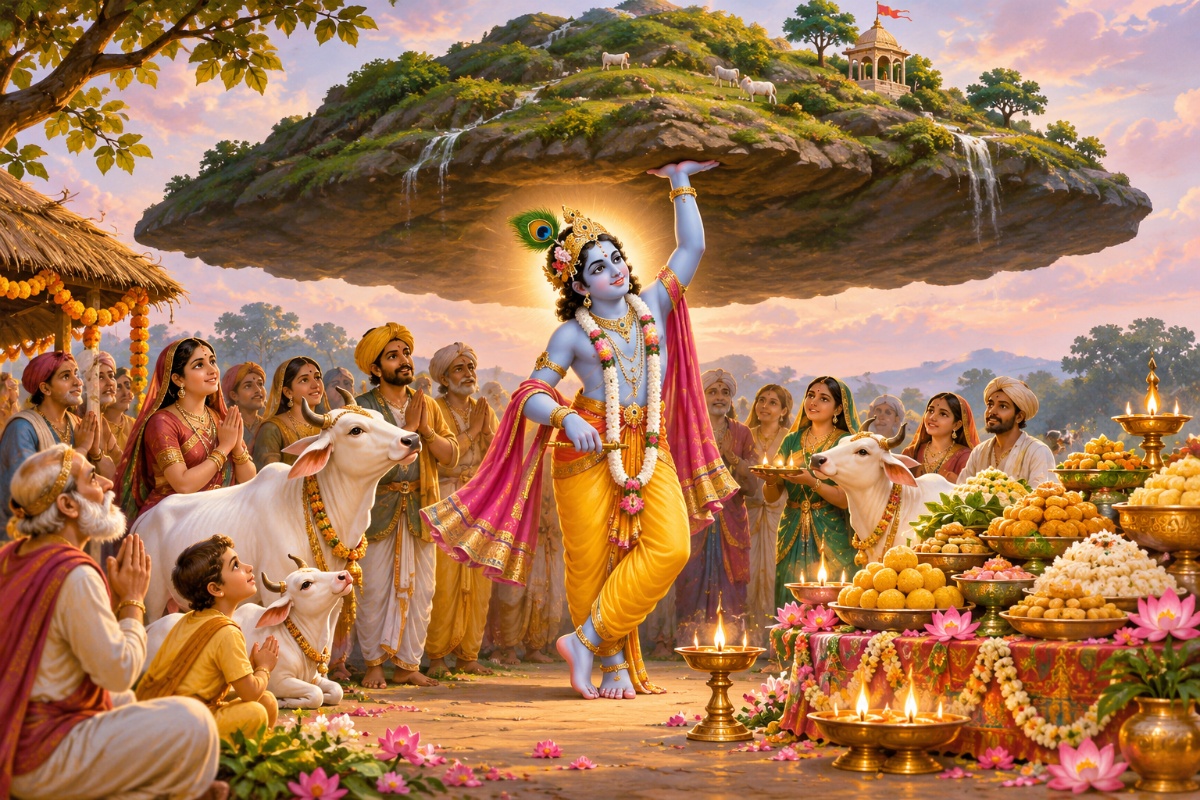
The story recounts that Lord Indra became angry when his worship was discontinued and sent heavy rainfall over the region. As the storm threatened the villagers and their cattle, Lord Krishna lifted Govardhan Hill on his little finger, providing shelter to everyone beneath it.
He held the mountain for seven days, protecting the people of Braj until the storm ended. Realising his mistake, Lord Indra acknowledged Krishna's divine power and his own pride.
The episode is remembered as a lesson in humility, faith and the importance of respecting the natural world. To this day, Govardhan Puja celebrates Lord Krishna as the protector of his devotees while reminding people of their responsibility towards the environment and the resources that sustain life.
Why Is Govardhan Puja Also Called Annakut Puja?
Another important aspect of Govardhan Puja is the tradition of Annakut. The Sanskrit-derived term Annakut refers to a mountain or heap of food.
On this occasion, devotees prepare different dishes and offer them to Lord Krishna as an expression of gratitude. In many Vaishnava temples, elaborate food offerings are arranged before the deity. These may include rice preparations, vegetables, sweets, lentils, grains, and other traditional dishes.
Some temples follow the custom of preparing Chappan Bhog, an offering of 56 food items. The Annakut tradition reflects the belief that food is a sacred gift and should be received with gratitude.
After the offering, the prepared food is distributed as prasad. Beyond its religious significance, Annakut also represents generosity, community participation and the sharing of blessings.
Also Read: Shani Dev Oil Offering vs Chhaya Daan
How Is Govardhan Puja Traditionally Performed?
The observance of Govardhan Puja differs across families and regions, but several customs are widely associated with the festival.
1. Preparing a Representation of Govardhan Hill
In many households, a small representation of Govardhan Hill is traditionally made using cow dung or clay.
It is decorated with flowers and other offerings before the puja begins.
This symbolic structure represents the sacred mountain associated with Lord Krishna.
2. Worshipping Lord Krishna
Devotees offer flowers, incense, lamps and food to Lord Krishna. Prayers and devotional songs are performed to remember the episode of Govardhan Hill and seek spiritual blessings.
3. Offering Annakut Bhog
A variety of vegetarian dishes are prepared and offered as bhog. The number and type of dishes depend on family traditions and available resources. A simple offering made with devotion is also part of many household practices.
4. Performing Govardhan Parikrama
Parikrama, or circumambulation, holds special importance during Govardhan Puja. In the Braj region, devotees visit Govardhan Hill and undertake its traditional parikrama route. At home, some families symbolically walk around the representation of Govardhan Hill while offering prayers.
5. Honouring Cows and Nature
Cows have a significant place in the traditions associated with Lord Krishna. In several communities, Govardhan Puja includes the bathing, decorating and worshipping of cattle. The practice also highlights the festival's connection with agriculture, nature and rural life.
Is Govardhan Puja Celebrated Differently Across India?
Although the central significance of Govardhan Puja remains connected with Lord Krishna, its observance reflects India's diverse religious customs.
Mathura and Vrindavan: The Braj region is particularly associated with the Govardhan episode. Devotees visit temples, offer Annakut bhog and participate in Govardhan Parikrama.
Gujarat: The period around Kartik Shukla Pratipada marks the beginning of the Gujarati New Year in many communities. Special prayers, visits to temples and family gatherings are common.
Maharashtra: The day is also associated with Bali Pratipada, which has its own religious narratives and cultural significance.
Vaishnava temples: Many temples organise large Annakut offerings, bringing devotees together for prayers, bhajans and prasad distribution.
These regional differences illustrate how a single lunar date can hold several interconnected meanings in the Hindu tradition.
What Does Govardhan Puja Teach Us Today?
The story of Govardhan Puja offers lessons that remain meaningful beyond the festival itself.
Lord Krishna's decision to honour Govardhan Hill highlights the importance of recognising the natural systems that support human life.
The mountain provided grazing land, vegetation and resources essential to the people of Braj.
The story also addresses the dangers of arrogance through Lord Indra's actions and the value of humility through his eventual acknowledgement of Krishna.
Another important message is the strength of community. According to the religious narrative, the people of Braj and their animals found protection together beneath Govardhan Hill.
Govardhan Puja, therefore, is not simply an occasion for performing rituals. It is also a reminder to express gratitude, respect nature and approach life with humility.
Also Read: Still Wearing That Old Kalawa?
Conclusion
Govardhan Puja 2026 falls on November 10 rather than November 9 because of the timing of Kartik Shukla Pratipada.
Although the lunar day begins on November 9, it prevails at sunrise on November 10, making Tuesday the traditionally observed date for the festival in New Delhi.
This one-day gap offers an opportunity to understand how the Hindu Panchang determines religious observances and why festival dates do not always follow a fixed Gregorian pattern.
More importantly, Govardhan Puja continues to carry a timeless message of devotion, humility, gratitude and respect for nature.
As devotees prepare to celebrate the festival, its story reminds us that faith is expressed not only through rituals but also through the way we value the world around us.
For more insights into Hindu festivals, Panchang traditions and spiritual practices, explore Viranchi.
Frequently Asked Questions
When is Govardhan Puja in 2026?
Why is Govardhan Puja not on November 9, 2026?
What is the auspicious time for Govardhan Puja in 2026?
Which deity is worshipped on Govardhan Puja?
Are Govardhan Puja and Annakut Puja the same?
Can Govardhan Puja be performed at home?
About the Author
Himanshu Mishra
@himanshu.mishra@paymeindia.in
View all posts →