
Why Does Maa Durga Arrive on a Different Vahan Every Navratri? Meaning of Her Arrival and Departure Vehicle
❤️ Spread the Love
Every Navratri, devotees welcome Maa Durga with prayers, fasting, Ghatasthapana and worship of her nine forms. But there is another fascinating tradition associated with the festival that often raises a question:
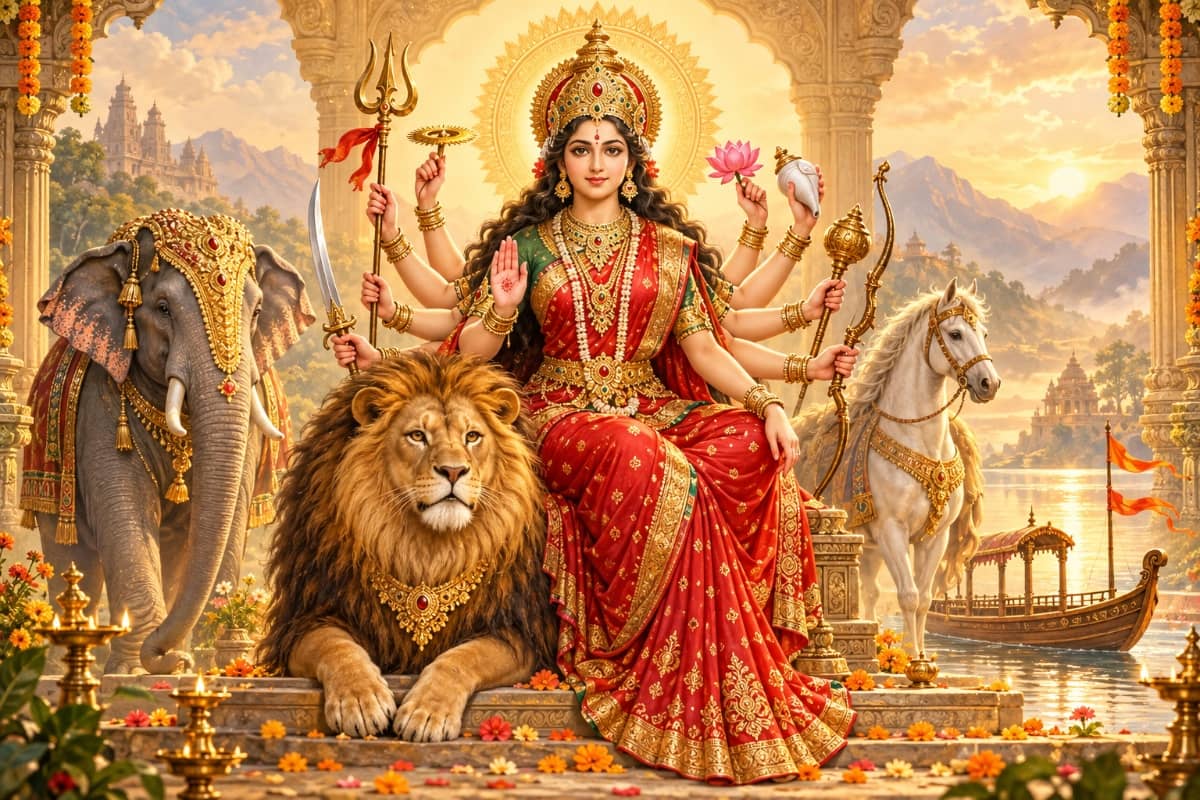
If Maa Durga's vahan is a lion, why do we hear every year that she is arriving on an elephant, horse, boat or palanquin?
In Shardiya Navratri 2026, Maa Durga is traditionally believed to arrive on an elephant or Gaja.
The reason lies in an old Panchang tradition in which the Goddess's symbolic vehicle for her arrival is determined by the weekday on which Navratri begins.
Let us understand what this tradition means, how Maa Durga's vahan is calculated and why her Navratri vehicle is different from her famous lion.
When Does Shardiya Navratri 2026 Begin?
Shardiya Navratri begins on Sunday, October 11, 2026.
The Pratipada Tithi of Ashwin Shukla Paksha begins on the night of October 10 and continues through October 11. Since the festival is observed according to the relevant sunrise-day tradition, Ghatasthapana and the first day of Navratri fall on October 11.
Event | Date |
|---|---|
Shardiya Navratri begins | October 11, 2026 |
Day | Sunday |
Maa Durga's traditional arrival vahan | Elephant – Gaja |
Maha Ashtami/Maha Navami observances | Around October 19 |
Vijayadashami/Dussehra | October 20, 2026 |
Maa Durga's Vahan in Navratri 2026
According to a traditional verse used in Panchang interpretations:
Shashi-Surye Gajarudha, Shani-Bhaume Turangame
Gurau Shukre Cha Dolayam, Budhe Nauka Prakirtita
The traditional interpretation is:
Sunday or Monday: Maa Durga arrives on an elephant
Tuesday or Saturday: she arrives on a horse
Thursday or Friday: she arrives in a palanquin
Wednesday: she arrives by boat
Since Navratri begins on a Sunday in 2026, Maa Durga's symbolic arrival vehicle is considered to be the elephant.
But Isn't Maa Durga's Vahan a Lion?
Yes.
The lion remains Maa Durga's principal and iconic vehicle in Hindu imagery and mythology.
The elephant, horse, boat or palanquin mentioned during Navratri has a different meaning.
Think of these as two separate traditions:
Type | Meaning |
|---|---|
Lion | Maa Durga's permanent/iconographic vahan |
Navratri arrival vahan | Symbolic vehicle determined by the weekday on which Navratri begins |
Therefore, saying that Maa Durga arrives on an elephant in 2026 does not mean that her lion has been replaced.
Instead, it refers to the traditional belief concerning how the Goddess symbolically arrives among her devotees during that year's Navratri.
What Does Maa Durga Arriving on an Elephant Mean?
In traditional interpretation, arrival on an elephant — Gaja is generally considered auspicious.
The elephant is associated with:
prosperity
stability
abundance
rainfall
good harvests
material well-being
A traditional verse associated with the vahan system links Maa Durga's elephant arrival with rainfall and agricultural abundance.
For this reason, devotees traditionally view Gaja arrival as a favorable indication.
However, these should be understood as religious and symbolic beliefs, not as guaranteed predictions about weather, economics or individual fortune.
Why Does Maa Durga's Vehicle Change Every Year?
The answer is surprisingly simple.
It changes because the weekday of Navratri changes.
If Pratipada falls on Sunday one year and Wednesday another year, the traditional arrival vehicle changes accordingly.
Maa Durga Arrival Vahan by Weekday
Navratri begins on | Traditional vahan |
|---|---|
Sunday | 🐘 Elephant |
Monday | 🐘 Elephant |
Tuesday | 🐎 Horse |
Wednesday | 🚤 Boat |
Thursday | Palanquin |
Friday | Palanquin |
Saturday | 🐎 Horse |
So the vehicle is not randomly selected every year.
It follows a traditional weekday-based system preserved in Panchang and festival interpretations.
What Do the Different Vahans Traditionally Signify?
Each vehicle has its own symbolism.
Elephant — Gaja
The elephant is considered one of the more auspicious vehicles.
It traditionally symbolizes rain, fertility, prosperity and abundant crops.
Its slow and powerful movement also naturally evokes stability and strength.
Horse — Turanga
The horse represents speed, movement and force.
Traditional interpretations sometimes associate the horse with restlessness, conflict or rapid change.
This should be understood as symbolic religious interpretation rather than a literal forecast.
🚤 Boat — Nauka
Arrival by boat is generally viewed positively.
Traditional interpretations connect it with fulfillment, abundance and favorable results, while water itself can represent nourishment and fertility.
Palanquin — Dola
The palanquin has traditionally received a more cautious interpretation.
Certain traditional verses associate it with instability, illness or collective difficulty.
Again, these are traditional omen interpretations, not scientific predictions.
Does Maa Durga Also Have a Different Departure Vehicle?
Yes.
Another fascinating part of the tradition is that arrival and departure are calculated separately.
The arrival vehicle depends on the weekday associated with the beginning of Navratri.
The departure vehicle is traditionally determined from the weekday associated with the Goddess's departure or Visarjan/Vijayadashami.
This is why the Goddess can symbolically arrive on one vehicle and depart on another.
For 2026, Vijayadashami is widely observed on Tuesday, October 20 in the Shardiya Navratri calendar.
Traditional sources show some variation in the terminology used for Tuesday departure. One Panchang tradition calls the Tuesday/Saturday departure vehicle Charanayudha, while popular festival interpretations sometimes describe this as a horse or weapon-associated vehicle.
This variation is worth noting because festival customs and Panchang traditions are not always expressed identically across different regions.
Why Is the Elephant Arrival Special in 2026?
The symbolism becomes especially interesting because elephants occupy an important place in Indian religious culture.
They represent:
Strength without haste: An elephant moves steadily rather than impulsively.
Royal dignity: Elephants historically represented royalty, authority and abundance.
Rain and fertility: Traditional Navratri interpretations specifically link Gaja arrival with good rainfall and agricultural prosperity.
Stability: Compared with the speed of a horse or movement of a boat, the elephant evokes grounded strength.
For devotees, therefore, Maa Durga arriving on Gaja can be understood as a symbolic reminder to pursue prosperity through patience, strength and stability.
Is the Vahan Prediction Meant for Individual Zodiac Signs?
Not necessarily.
This is an important distinction.
The traditional Maa Durga vahan interpretation is generally presented as a collective omen associated with the year or festival, rather than a personalized prediction for one person's zodiac sign.
If someone wants to understand their individual career, marriage, finances or health during Navratri, that requires a different astrological analysis involving their birth chart, planetary periods and current transits.
Therefore:
Maa Durga's vahan = traditional collective symbolism
Personal horoscope = individual astrological interpretation
The two should not be confused.
What Can Devotees Learn From the Symbolism?
The deeper value of this tradition may not lie in predicting exactly what will happen during the year.
Instead, every vahan can be viewed as carrying a message.
In 2026, the elephant reminds devotees of qualities such as:
patience
stability
responsibility
generosity
strength
respect for nature
gratitude for abundance
Navratri itself celebrates Shakti, the divine power that enables transformation.
The symbolism of the elephant therefore fits beautifully with the idea that true strength does not always need to be loud or aggressive. Sometimes the greatest power is steady, disciplined and grounded.
Conculsion
Shardiya Navratri 2026 begins on Sunday, October 11, and according to traditional weekday-based calculations, Maa Durga is believed to arrive on an elephant.
While Maa Durga's eternal and iconic vahan remains the lion, the elephant represents her symbolic Navratri arrival vehicle for the year.
Traditional belief associates Gaja with prosperity, rainfall, abundance and stability, making the Goddess's arrival on an elephant generally regarded as auspicious.
More importantly, the tradition reminds us that Navratri is not merely about predicting what lies ahead.
It is a celebration of strength, discipline, devotion and the victory of wisdom over negativity.
And perhaps the elephant carries the most relevant message of all:
Move forward with strength—but without losing stability.
Frequently Asked Questions
On which vehicle will Maa Durga arrive in Navratri 2026?
Why does Maa Durga's vehicle change every Navratri?
Isn't the lion Maa Durga's vehicle?
Is Maa Durga arriving on an elephant considered auspicious?
How is Maa Durga's departure vehicle decided?
About the Author
Himanshu Mishra
@himanshu.mishra@paymeindia.in
View all posts →