
Why Do We Bid Farewell to Maa Durga After Welcoming Her?
❤️ Spread the Love
The flowers are still fresh. The sound of the dhaak still feels close. Only a few days ago, everyone was waiting for Maa Durga to arrive. Now, the same people are preparing to say goodbye.
For anyone watching Durga Puja for the first time, this can feel puzzling. Why put so much love into welcoming the goddess if her idol will soon be immersed?
The question becomes more moving when you look beyond the procession. In Bengal’s Durga Puja tradition, the farewell belongs to a larger story about family, homecoming and the emotions that accompany a beloved visitor’s departure.
Maa Durga’s Arrival Has a Family Story
Durga Puja celebrates the goddess’s victory over Mahishasura. But in the Bengali homecoming tradition, she is also imagined as a daughter visiting her parents’ home with Lakshmi, Saraswati, Ganesha and Kartik. Incredible India describes this family homecoming as a central part of the celebration.
A daughter’s visit carries its own kind of happiness. There are preparations before she arrives, conversations that stretch longer than expected and the wish that she could stay a little more.
This offers a way to understand the festival’s tenderness. Devotion becomes connected with a familiar human experience: welcoming someone whose presence makes a home feel complete.
Also Read : Why Does Maa Durga Arrive on a Different Vahan Every Navratri?
For someone returning home after months away, that feeling may be especially easy to recognise. The visit has an ending, but knowing that does not make the welcome any less heartfelt.
What Does Visarjan Represent?
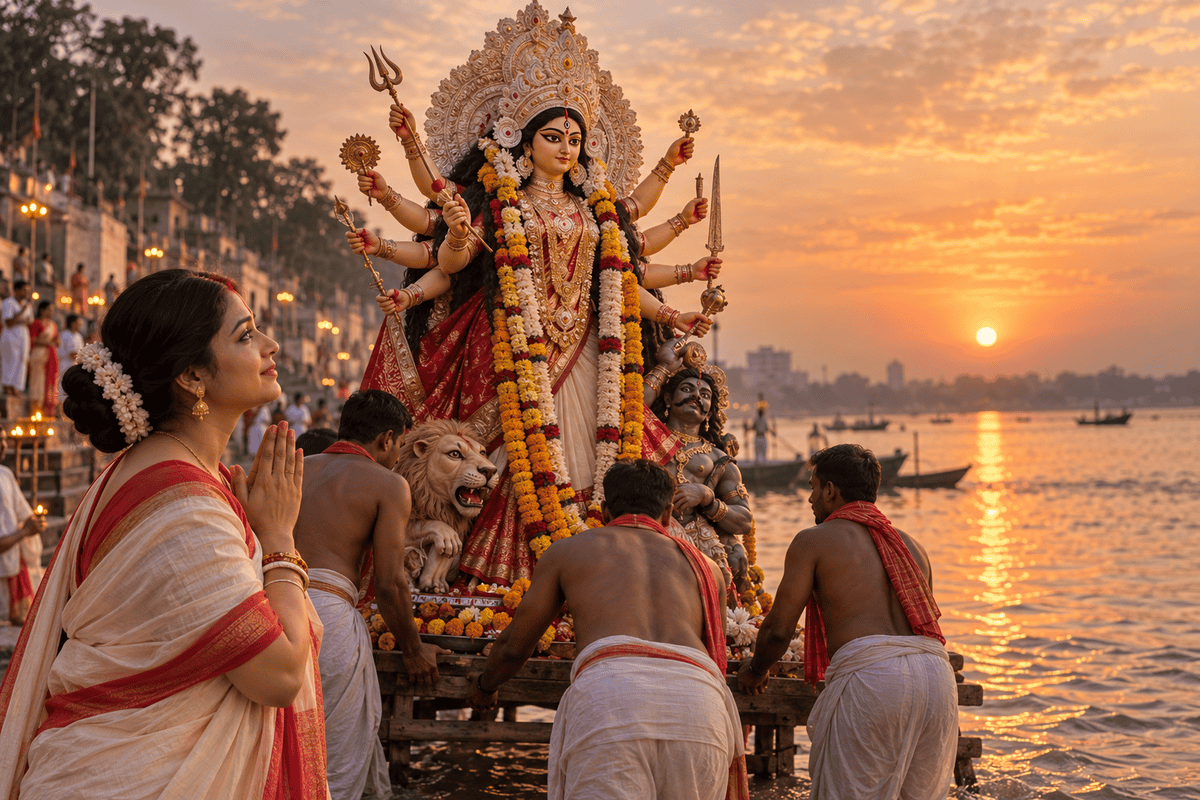
Visarjan refers to the ritual immersion of the festival idol. Within the Bengali homecoming narrative, the immersion symbolises Maa Durga’s return to her abode in the Himalayas.
The farewell therefore completes the story of her visit. Arrival, worship and departure belong to the same festive journey.
This helps explain why Dashami can carry mixed emotions. A devotee may feel grateful for the celebrations and sad that they are ending. Those feelings can exist together.
Think of a family gathering that everyone looked forward to. Its final day often brings both satisfaction and reluctance. You are glad it happened, yet you wish there were another evening left.
That comparison is a reflection on the festival’s emotional meaning, rather than a prescribed religious explanation. It makes the farewell easier to relate to without reducing it to a single lesson.
The Idol Holds More Than Its Physical Form
Before an idol becomes the focus of prayers, it is an object of patient craftsmanship. Kolkata’s Kumartoli neighbourhood is known for its clay idol makers, who create images for Durga Puja and other worship traditions.
UNESCO also recognises the festival’s connection with crafts, music, food and performance. Durga Puja in Kolkata joined its Representative List of the Intangible Cultural Heritage of Humanity in December 2021.
During a celebration, an idol can become associated with very personal memories: a prayer offered quietly, a visit with grandparents or a child’s first glimpse of the goddess.
This is why its departure may feel different from taking down ordinary festive decorations. The form has become connected with experiences that matter to the people gathered around it.
From a reflective perspective, immersion invites us to consider how those memories continue after the physical centre of the celebration is gone.
Also Read : Why Is This Tree Worshipped on Dussehra? The Meaning Behind Shami Puja
Does Farewell Mean Devotion Has Ended?
It is possible to understand the farewell as a change in how devotion is expressed. During the festival, attention gathers around a particular idol and shared place of worship. Afterwards, a devotee may carry that experience into quieter parts of everyday life.
For one person, that might mean making time for prayer. For another, it could mean remembering the strength they sought during a difficult period or continuing the care they showed to family during the celebrations.
These are personal possibilities, rather than rules that every devotee must follow. The useful question is simple: what would you like to carry forward from the days you spent in worship?
An answer does not have to be grand. Patience, gratitude or a little more attention to someone at home can make the festive experience meaningful beyond its closing day.
Why a Temporary Celebration Can Leave a Lasting Mark
A celebration’s length does not necessarily decide its importance.
A few days spent with family can remain memorable for years. A short conversation can bring comfort long after it ends. The value of an experience often lies in the attention and affection given to it.
Durga Puja can be approached through that same lens. Its limited duration encourages us to notice the time we have: to join a prayer, visit someone or simply pause.
This is an interpretation readers may reflect on, rather than a claim about the ritual’s historical origin.
The farewell then becomes an opportunity to ask whether we were fully present during the welcome—and how we might bring that presence into ordinary days.
What can devotees reflect on after the festival?
They can consider what the celebration meant personally and which values or habits they would like to continue. There is no single answer for everyone.
The farewell may close the festival, but it leaves space for memory, reflection and another welcome.
Frequently Asked Questions
Why is Maa Durga’s idol immersed after Durga Puja?
Why is Maa Durga welcomed as a daughter in Bengal?
What is the significance of Vijayadashami?
Does Durga Visarjan mean worship ends?
About the Author
Himanshu Mishra
@himanshu.mishra@paymeindia.in
View all posts →