
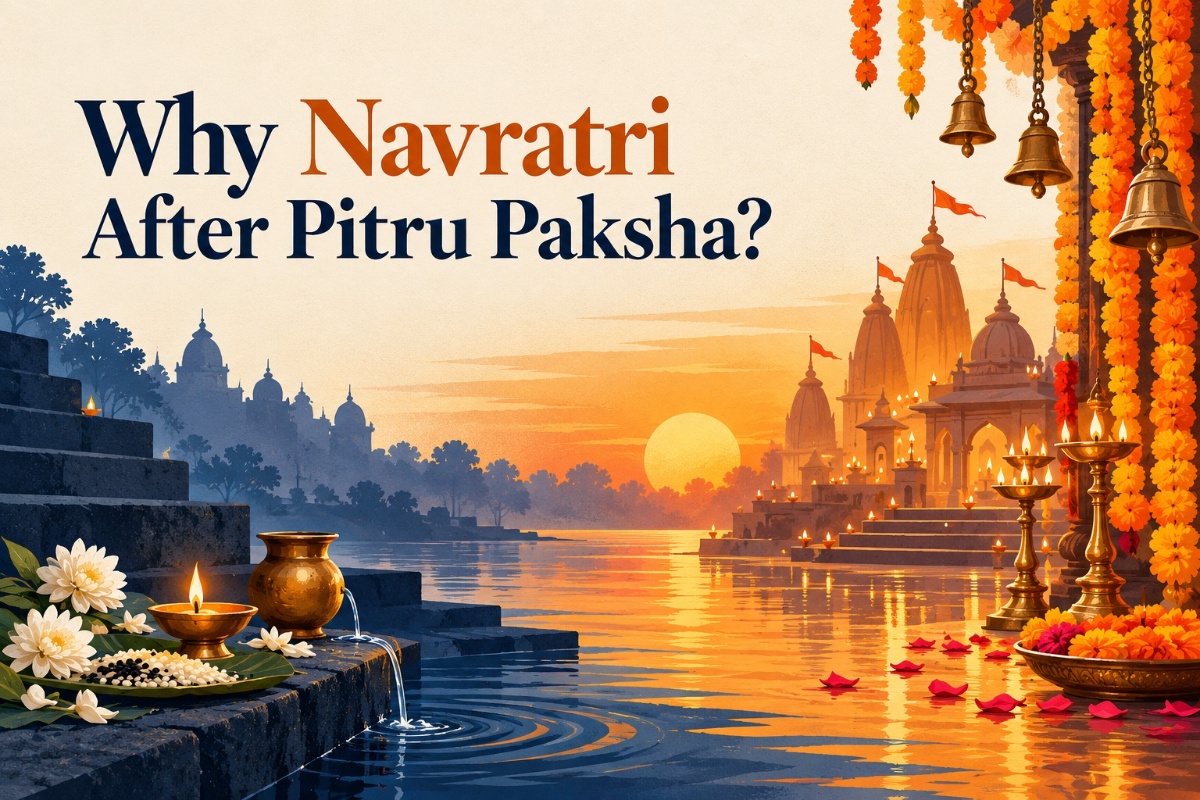
Why Does Navratri Begin After Pitru Paksha?
❤️ Spread the Love
Pitru Paksha and Sharadiya Navratri are two deeply significant periods in the Hindu calendar. Yet, their energies and rituals appear remarkably different.
Pitru Paksha is dedicated to remembering ancestors, performing Shraddha, offering Tarpan, and expressing gratitude toward one's lineage. Navratri, on the other hand, is a vibrant nine-night celebration devoted to Goddess Durga and her manifestations of Shakti.
This creates an interesting question: Why does Navratri begin almost immediately after Pitru Paksha ends?
The transition carries a profound symbolic meaning. It represents a movement from remembrance and ancestral gratitude toward purification, divine energy, action, and spiritual renewal.
Let's understand this connection through Hindu tradition and the lens of Vedic astrology.
Pitru Paksha: A Period of Remembering Our Ancestors
Pitru Paksha is traditionally observed during the Krishna Paksha, or waning phase of the Moon, in the lunar month associated with this ancestral observance.
The period is dedicated to the Pitrs—one's departed ancestors. Families traditionally perform acts such as Shraddha, Tarpan, Pind Daan, food offerings, and charity according to their family customs and regional traditions. The central principle behind these practices is remembrance and gratitude.
Spiritually, Pitru Paksha reminds us that our lives do not exist in isolation.
Our family, values, opportunities, traditions, and even many of our responsibilities are connected to generations that came before us. Therefore, Pitru Paksha can be understood as a period of acknowledging our roots before moving toward a new phase of spiritual activity.
Why Is the End of Pitru Paksha Significant?
Pitru Paksha concludes with Sarva Pitru Amavasya, also known in many traditions as Mahalaya Amavasya.
Amavasya marks the New Moon phase, when the visible illumination of the Moon reaches its minimum.
In Hindu spiritual traditions, Amavasya is frequently associated with introspection, remembrance, withdrawal, and inward-focused practices. The conclusion of Pitru Paksha therefore symbolically completes a period devoted to looking backward—toward lineage, memory, inherited responsibilities, and gratitude.
What follows is a movement toward Shakti. And this is where Navratri begins.
Navratri Represents the Awakening of Shakti
Sharadiya Navratri begins during the Shukla Paksha, the waxing phase of the Moon.
As the lunar light gradually increases night after night, devotees worship different manifestations of Goddess Durga.
Symbolically, the sequence is powerful:
Pitru Paksha → Amavasya → Shukla Paksha → Navratri → Vijayadashami
It can be understood as a spiritual journey:
Remembrance → Completion → Renewal → Shakti → Victory
Navratri is therefore not merely a festival that happens to follow Pitru Paksha on the calendar. The sequence can be viewed as a transition from honoring what came before us to consciously awakening the energy required for what comes next.
The Astrological Significance of This Transition
In Vedic astrology, the Moon (Chandra) has an important connection with the mind, emotional experience, receptivity, and inner awareness.
The movement from Krishna Paksha toward Amavasya represents decreasing lunar illumination. After Amavasya, the Moon begins waxing again during Shukla Paksha. From a symbolic astrological perspective, this transition beautifully complements the nature of these observances.
Pitru Paksha encourages remembrance, reflection, gratitude, and karmic awareness. Navratri shifts the focus toward Shakti, discipline, devotion, courage, and transformation.
Classical Jyotisha itself evaluates life through interconnected factors such as Grahas, Rashis, Bhavas, planetary strength, aspects, and planetary periods rather than interpreting an event through one isolated factor.
This is important because the spiritual symbolism surrounding Pitru Paksha and Navratri should not be reduced to simplistic claims such as one planet automatically creating ancestral problems or one ritual automatically changing a horoscope.
Also Read: Hindu Festivals in October 2026
From Pitru to Shakti: The Deeper Spiritual Message
The sequence between these two observances contains an important lesson.
Before seeking power, acknowledge your roots. Before beginning something new, recognize what shaped your present. Before asking the Divine Mother for strength, remember those through whom your life and lineage continued. This creates a beautiful spiritual progression.
During Pitru Paksha, a person symbolically looks toward the past. During Navratri, attention returns to the present and future.
One period emphasizes gratitude; the next emphasizes transformation. In this sense, Pitru Paksha and Navratri are not opposing observances. They can be seen as complementary stages of a larger spiritual cycle.
Is There a Connection Between Pitru Paksha and Karma?
Karma is an important concept in both Hindu philosophy and Jyotisha. However, ancestral karma should not automatically be interpreted as punishment.
Family patterns can appear in many forms—values, responsibilities, relationships, financial habits, emotional conditioning, cultural traditions, and spiritual practices.
Jyotisha traditionally studies different areas of life through houses and planetary relationships. A responsible horoscope analysis therefore considers the complete birth chart rather than declaring "Pitru Dosha" merely because of one planetary conjunction.
This distinction is particularly important today, when fear-based interpretations of Pitru Dosha are common online.
Astrology should encourage awareness and constructive action rather than unnecessary fear.
What Should You Do During This Transition?
The transition from Pitru Paksha to Navratri can be approached simply and meaningfully.
Complete ancestral observances according to your family tradition, express gratitude toward elders and ancestors, practice charity where possible, clean your home and worship space, resolve unnecessary family conflicts, and enter Navratri with a calmer and more disciplined mindset.
You do not necessarily need elaborate remedies. The deeper principle is Karma.
Respecting parents and elders, helping people in need, maintaining integrity within the family, fulfilling responsibilities, and correcting harmful patterns can be meaningful ways of honoring both ancestral values and the spirit of Shakti.
Conculsion
The transition from Pitru Paksha to Navratri tells a powerful story.
First, remember. Then, release. Then, rebuild.
Pitru Paksha connects us with lineage, gratitude, and inherited responsibilities. Navratri turns our attention toward Shakti—the strength required to transform ourselves and move forward.
Together, these observances remind us that spiritual progress is not about forgetting the past. It is about acknowledging our roots, learning from them, and consciously creating better karma for the future.
For those interested in exploring how ancestral themes, planetary placements, houses, Dashas, and karmic patterns may appear in their individual birth chart, Viranchi AI can help transform these traditional Jyotisha concepts into a personalized Vedic astrology analysis.
Frequently Asked Questions
Does Navratri always begin immediately after Pitru Paksha?
Why are major celebrations generally avoided during Pitru Paksha?
Is Pitru Dosha the reason Pitru Paksha is observed?
What does Navratri symbolize astrologically?
About the Author
Himanshu Mishra
@himanshu.mishra@paymeindia.in
View all posts →