
Why Do These Places Remember Ravana Differently on Dussehra?
❤️ Spread the Love
The Ravana effigy is usually the first thing you notice at a Dussehra ground. It towers above the crowd, sometimes taller than the buildings nearby. Children watch it impatiently while adults try to find a spot with a better view. Everyone knows what happens next.
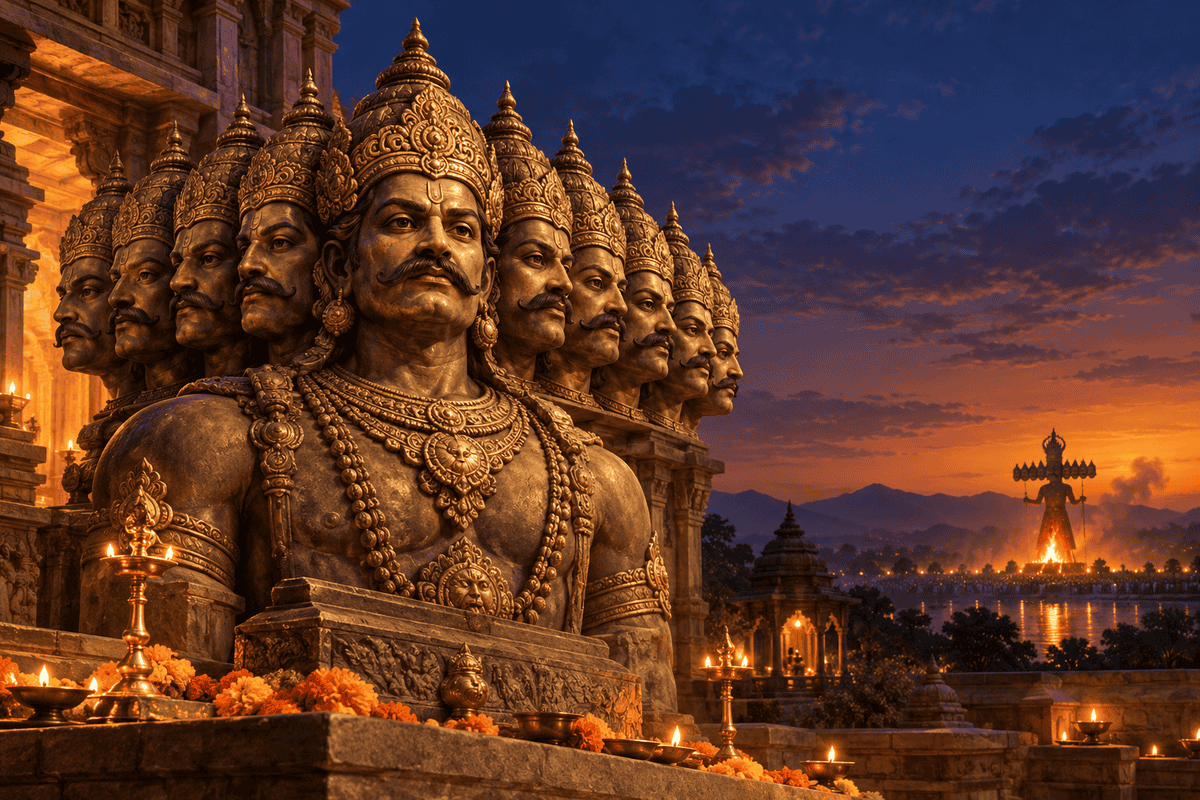
But travel beyond these celebrations, and you will find communities whose connection with Ravana is more personal. Some regard him as an ancestor. Others honour him through a local belief about his marriage to Mandodari. In certain places, his devotion to Lord Shiva is the reason his effigy remains unburnt.
These customs have their own stories, and understanding them takes more than a list of places where Ravana is worshipped.
Also Read: Same Zodiac Sign but Different Lives
A Different Relationship With a Familiar Character
For most people, Ravana’s role in the Ramayana defines how he is remembered on Dussehra. His defeat at the hands of Lord Rama carries the festival’s message of righteousness overcoming wrongdoing.
Within some communities, however, another relationship has been passed down alongside that familiar story. Ravana may also be remembered as a learned figure, a Shiva devotee or someone connected to the community’s own origins.
That relationship helps explain the custom. It also explains why two places that honour Ravana might observe Dussehra in entirely different ways.
Mandsaur’s Tradition Has an Unexpected Second Half
In Khanpura, an area of Mandsaur in Madhya Pradesh, the Namdev Chhipa community honours Ravana as a son-in-law. The connection comes from a local belief that his wife, Mandodari, belonged to their community.
Once Ravana is understood as their jamai, the respect shown to him becomes easier to follow. Devotees gather at his statue and offer prayers on Dussehra.
Yet this is only one part of the day.
Accounts of the custom also describe a symbolic enactment of his defeat in the evening, after forgiveness is sought. The same observance makes room for both the relationship and his downfall.
This detail is often lost when Mandsaur is described simply as a place that worships Ravana. The tradition is more layered than that. Respecting the son-in-law does not remove the ending of the epic from the celebration.
For Some Jodhpur Families, the Connection Is Ancestral
In Jodhpur, certain families belonging to the Godha gotra of the Shrimali Brahmin community believe they are descendants of Ravana.
For them, Dussehra includes mourning and remembrance. They avoid watching his effigy being burnt and remember his scholarship and devotion to Shiva. Reported family customs include bathing, changing the sacred thread and offering prayers before eating after the evening’s Ravana Dahan.
These practices belong to particular households. They do not describe how everyone in Jodhpur observes the festival.
The ancestry itself is an inherited belief rather than a verified genealogy. But within those families, it gives the day an emotional meaning: the figure whose defeat is being celebrated outside is someone they regard as an ancestor.
Bisrakh’s Story Begins With the Village Itself
Near Greater Noida, Bisrakh has a local tradition identifying it as Ravana’s birthplace.
Some residents therefore see him as a figure connected to their own land and ancestry. They offer prayers rather than burn his effigy. The village’s Shiva temple is also associated with stories about Ravana and his father, sage Vishrava.
The birthplace claim belongs to religious belief and local folklore. It should not be treated as a historically established location.
Still, it explains something about the village’s relationship with the story. Ravana is not remembered only as the ruler of Lanka. In the tradition followed by these residents, his beginnings are connected to the place they call home.
In Baijnath, Devotion Shapes the Custom
Baijnath, in Himachal Pradesh’s Kangra district, has another reason for avoiding Ravana Dahan.
The local explanation centres on Ravana’s devotion to Lord Shiva. Respect for that devotion is described as the reason his effigy is not burnt.
Unlike the traditions built around marriage or ancestry, this connection is religious. The aspect of Ravana remembered here is the devotee.
Stories about misfortune following attempts to burn his effigy also circulate around the custom. These are part of local folklore, not proof that effigy burning causes harm.
Also Read: Why Does Maa Durga’s Vahan Change Every Navratri?
Why These Stories Deserve More Than a Surprising Headline
“People worship Ravana here” is an attention-grabbing statement. It is also incomplete.
In one community, the custom involves honouring a son-in-law before symbolically marking his defeat. In another, families mourn someone they believe to be an ancestor. Elsewhere, residents avoid burning an effigy out of respect for a Shiva devotee.
Prayer, mourning and the absence of Ravana Dahan each have a different meaning. Even within the same town, a custom may belong to only one community.
These distinctions make the stories worth reading. They show how an epic becomes woven into family beliefs and local traditions, sometimes in ways that are unfamiliar to people living just a few hours away.
The next time you see Ravana’s effigy rising above a Dussehra ground, you may remember that the festival holds other stories too—preserved in village temples, community rituals and family memories.
Disclaimer: This article explores reported regional traditions, religious beliefs and folklore. Practices vary across communities. Claims about mythological birthplace, ancestry and supernatural consequences are not presented as verified historical or scientific facts.
Frequently Asked Questions
Why do some communities worship Ravana on Dussehra?
Where is Ravana worshipped or honoured in India?
Why is Ravana considered a son-in-law in Mandsaur?
Does Ravana worship mean his defeat is not observed?
About the Author
Himanshu Mishra
@himanshu.mishra@paymeindia.in
View all posts →