Shani Dev Oil Offering vs Chhaya Daan: What's the Difference and Which Ritual Should You Perform?
❤️ Spread the Love
Saturday holds special significance in Hindu religious traditions, particularly for devotees of Lord Shani. Many people visit Shani temples, offer mustard oil, light lamps, and make donations while seeking blessings and relief from life's difficulties.
However, there is one common confusion surrounding Saturday worship: Is offering oil to Shani Dev the same as performing Chhaya Daan?
Although both rituals involve oil and are associated with Lord Shani, their purposes and procedures differ.
Understanding this distinction can help devotees follow their preferred traditions more clearly.
Why Is Mustard Oil Offered to Shani Dev?
In Hindu astrology, Shani (Saturn) is associated with karma, justice, responsibility, patience, and discipline.
According to religious beliefs, Lord Shani represents the consequences of one's actions. His influence is traditionally associated with important life lessons involving perseverance, accountability, and personal growth.
Offering oil to Shani Dev is a long-established practice, especially on Saturdays.
Devotees commonly use mustard oil or sesame oil during Shani worship. The offering is considered an expression of devotion and a symbolic request for peace and protection.
Some traditions also associate oil offerings with Shani-related astrological periods, including Shani Sade Sati and Dhaiya.
However, it is important to understand that offering oil is a religious practice, not a guaranteed solution to financial, professional, or personal difficulties.
Also Read: Bhakoot Dosha in Kundli Matching
What Is Chhaya Daan in Astrology?
Chhaya Daan is a traditional donation ritual associated with Lord Shani. The word Chhaya means shadow or reflection, while Daan means donation.
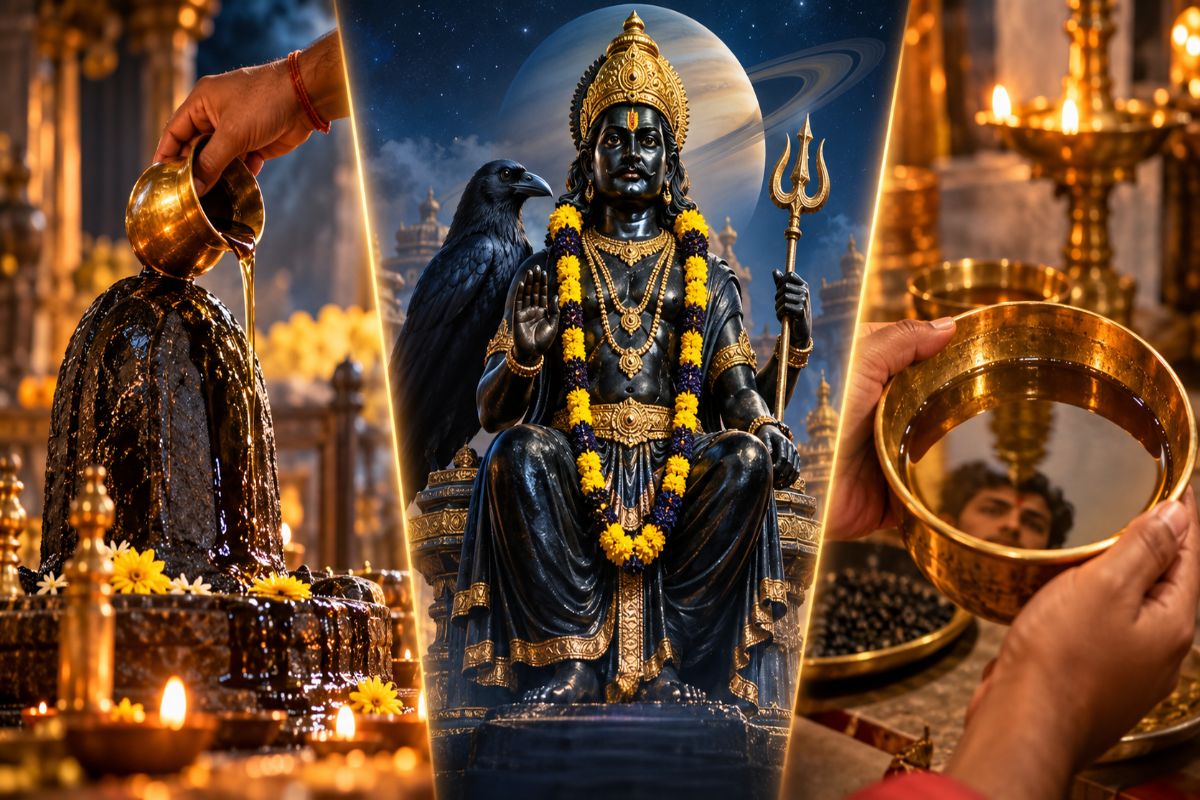
Unlike a regular oil offering, Chhaya Daan involves looking at one's reflection in oil before donating it. According to commonly followed traditions, devotees pour mustard oil into a small vessel and look at their reflection on its surface. The oil is then donated according to the local religious custom.
The ritual is traditionally associated with seeking Shani Shanti, or peace from difficulties attributed to Saturn in astrology.
Why Is Seeing Your Reflection Important?
The reflection is the distinguishing element of Chhaya Daan. In some interpretations, looking at one's reflection is understood as a symbolic act of self-awareness and surrender.
The subsequent donation represents an offering made with humility and devotion.
While different traditions may explain its spiritual symbolism differently, the reflection-and-donation process is what generally distinguishes Chhaya Daan from an ordinary oil offering.
Also Read: Can Your Name Sign and Birth Sign Be Different?
Shani Dev Oil Offering vs Chhaya Daan: Key Differences
Although both rituals are associated with Shani Dev, they differ in their methods.
Aspect | Oil Offering to Shani Dev | Chhaya Daan |
|---|---|---|
Main purpose | Worship and devotion | Symbolic donation associated with Shani Shanti |
Main material | Mustard or sesame oil | Usually mustard oil |
Procedure | Oil is offered at a permitted worship location | Reflection is viewed in oil before donation |
Reflection required? | Not generally necessary | Commonly included |
Where performed? | Shani temple or designated worship area | Donation location or temple, according to custom |
Associated day | Commonly Saturday | Commonly Saturday |
The distinction lies primarily in the procedure rather than any universally established difference in spiritual results. Some regional traditions combine elements of both rituals.
Also Read: Wrong Birth Time in Your Kundli?
How to Perform Chhaya Daan on Saturday
The traditional method of Chhaya Daan is relatively simple. However, practices may differ between families, temples, and regional customs.
Step 1: Prepare the Necessary Items
Take a small, clean vessel and some mustard oil. Certain traditions prefer an iron bowl, although this is not a universal requirement.
Step 2: Pour Oil into the Vessel
Pour enough oil into the vessel to create a reflective surface. There is no need to use a large quantity.
Step 3: Look at Your Reflection
Hold the vessel carefully and look at your reflection in the oil. This step is central to the commonly followed Chhaya Daan ritual.
Step 4: Offer a Prayer to Shani Dev
You may offer a simple prayer or chant:
ॐ शं शनैश्चराय नमः
Om Sham Shanaishcharaya Namah
This mantra is traditionally associated with Lord Shani.
Also Read: Still Wearing That Old Kalawa? Here's What You Should Know
Step 5: Donate the Oil
After viewing your reflection, donate the oil according to the religious practice you follow. Some traditions involve donating the oil along with the vessel. Others allow devotees to place it in a designated donation container at a temple.
Always check the temple's rules before donating.
How Is Oil Offered to Shani Dev?
Offering oil to Shani Dev is generally associated with the practice known as Tailabhishek, in which oil is offered to a deity's idol or sacred stone.
The customary procedure may involve visiting a Shani temple, offering prayers, and presenting mustard or sesame oil. However, not every temple permits devotees to pour oil directly onto the idol.
Some temples maintain separate oil collection vessels to preserve cleanliness and manage offerings. Devotees should follow the instructions provided by the temple authorities.
Unlike Chhaya Daan, viewing one's reflection in the oil is not generally an essential part of an ordinary oil offering.
Can You Perform Chhaya Daan and Oil Offering Together?
Yes, some religious traditions combine the two practices. For example, a devotee may look at their reflection in mustard oil before offering it at a Shani temple.
However, other traditions treat Chhaya Daan specifically as a donation rather than an offering poured onto an idol. This explains why different temples and families may follow different procedures. There is no need to assume that one regional custom is universally correct or that following another accepted tradition is inauspicious.
Is Lighting a Mustard Oil Diya the Same as Chhaya Daan?
No. Lighting a mustard oil lamp and performing Chhaya Daan are generally considered different practices. A mustard oil diya is commonly associated with Saturday worship and prayers to Shani Dev.
Chhaya Daan, on the other hand, involves viewing one's reflection in oil and subsequently donating it. Lighting a lamp does not automatically complete the traditional Chhaya Daan procedure. Although devotees may perform both acts during the same worship session, they have distinct ritual identities.
What Is the Significance of Chhaya Daan During Shani Sade Sati?
Shani Sade Sati refers to an approximately seven-and-a-half-year astrological period associated with Saturn's transit around the natal Moon sign.
In traditional Vedic astrology, this period is associated with themes such as responsibility, discipline, patience, and changes in personal circumstances. Some astrologers recommend donations, prayers, and charitable activities during Sade Sati as religious remedies.
Chhaya Daan is among the practices traditionally associated with seeking Shani Shanti. However, performing Chhaya Daan does not automatically end Sade Sati or guarantee the removal of difficulties.
Astrological interpretations depend on multiple factors, including the overall birth chart and planetary positions.
Common Mistakes to Avoid During Shani Worship
A few practical considerations can help devotees perform these rituals respectfully.
Confusing every oil offering with Chhaya Daan: Offering oil and viewing one's reflection before donating oil are not necessarily the same procedure.
Ignoring temple guidelines: Some temples restrict pouring oil directly onto idols. Always follow the permitted method.
Believing that more oil produces greater blessings: Religious devotion is not measured by the quantity or cost of offerings.
Wasting or spilling oil: Oil should be handled carefully and placed in appropriate containers.
Following rituals out of fear: Small differences in regional customs should not become a source of anxiety.
Above all, religious practices are traditionally connected with devotion, humility, and good conduct.
What Matters More: Rituals or Karma?
One of the central teachings associated with Shani Dev is the importance of karma. In Hindu astrology and religious belief, Shani is often described as a symbol of justice, discipline, and accountability.
This association highlights the value of honesty, patience, responsibility, and treating others fairly. From this perspective, charity and prayer can be viewed as opportunities for spiritual reflection rather than transactions that guarantee particular outcomes.
Whether someone performs Chhaya Daan, offers oil, or simply prays on Saturday, the underlying intention remains significant.
Conclusion
Shani Dev oil offering and Chhaya Daan are closely related religious traditions, but they are not necessarily identical.
The primary difference lies in their methods. Oil offering focuses on presenting oil during worship, while Chhaya Daan commonly involves viewing one's reflection in oil before donating it.
Both practices are associated with devotion to Lord Shani, especially on Saturdays.
Rather than worrying about minor differences in ritual methods, devotees can focus on sincere prayers, responsible conduct, and respect for their religious traditions.
For more insights into Vedic astrology, planetary influences, and Hindu traditions, explore Viranchi.
Disclaimer: This article discusses traditional Hindu religious and astrological beliefs for informational purposes. Ritual practices vary by region and religious community. Astrological remedies are matters of faith and do not guarantee particular outcomes.
Frequently Asked Questions
Is Chhaya Daan different from offering mustard oil to Shani Dev?
Which oil is commonly used for Chhaya Daan?
Can Chhaya Daan be performed at home?
Is Saturday necessary for Chhaya Daan?
Does Chhaya Daan remove Shani Dosha?
Can I offer oil after looking at my reflection?
About the Author
Himanshu Mishra
@himanshu.mishra@paymeindia.in
View all posts →